Definitions
This page provides definitions for key terms used throughout the Syndata platform and setup documentation. Understanding these concepts will help you correctly prepare and interpret your data.
Condition
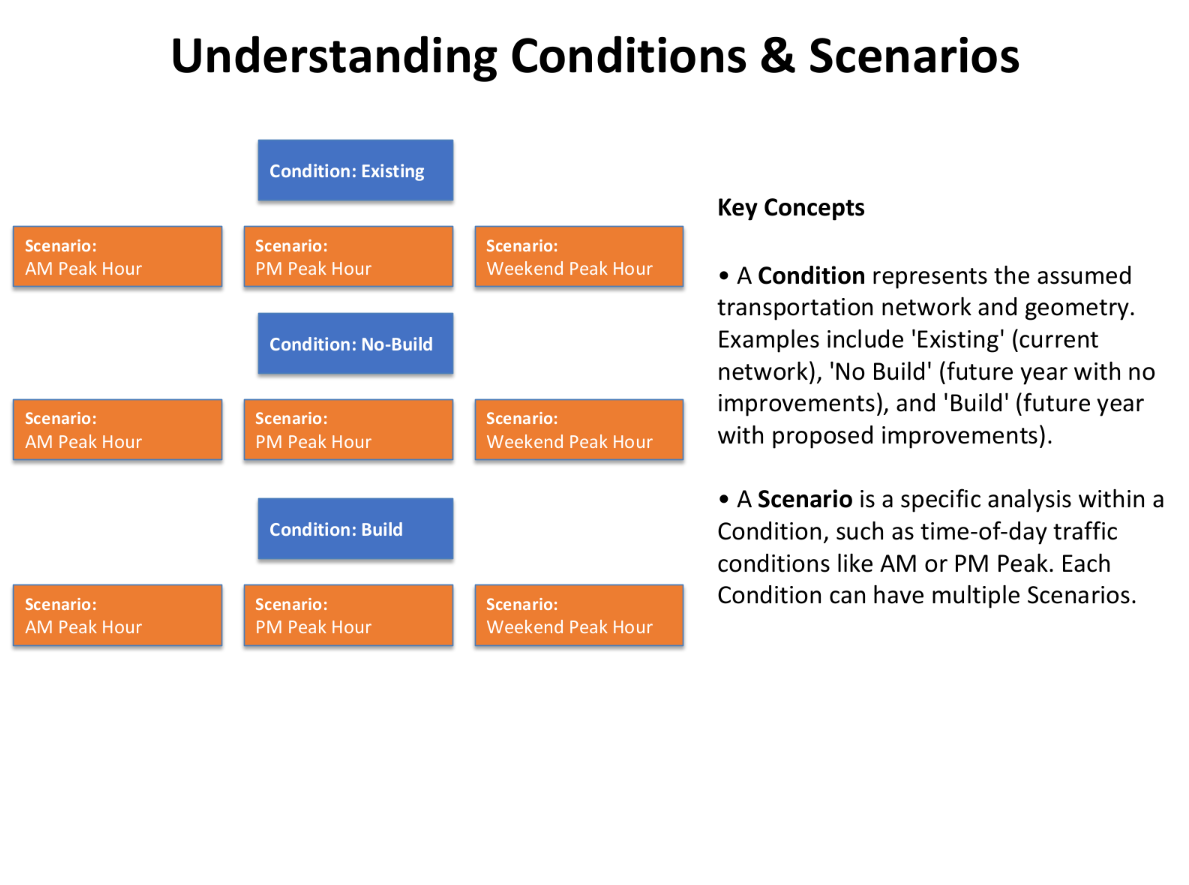
A condition refers to the overall context or state under which traffic data is being analyzed or modeled. It typically reflects the stage of a project or planning scenario.
Common Condition Types
-
Existing Condition
Represents current, real-world traffic operations based on observed data. -
No Build Condition
A future-year scenario that assumes no infrastructure improvements are made (i.e., a "do nothing" baseline). -
Build Condition
A future-year scenario that incorporates proposed development or infrastructure improvements (i.e., a "with project" case).
Each condition sets the framework for evaluating how traffic behaves under a specific planning or design context.
Scenario
A scenario defines the time-of-day traffic condition within a given condition. It determines the peak or relevant periods used for analysis.
Typical Scenarios
-
AM Peak
Morning rush hour conditions (e.g., 7:00–9:00 AM) -
Midday (MD)
Midday conditions, often used for school or retail-focused analyses -
PM Peak
Evening rush hour conditions (e.g., 4:00–6:00 PM) -
Saturday Peak
Weekend traffic periods, commonly used in retail, entertainment, or recreational impact studies
Scenarios are always nested within a condition.
Example Combinations
These are some example pairs of condition + scenario used in report generation:
Existing Condition – AMBuild Condition – PMNo Build Condition – Saturday
Additional Notes
- Every
.txtreport exported from Synchro must clearly indicate its associated condition and scenario. - Avoid leaving these fields blank, duplicated, or inconsistent, as this can lead to processing errors within Syndata.